David
Cassidy, in his lawsuit vs. Sony over his share of the revenue from
"
The Partridge Family," cites the show's runaway success in
merchandising, including "
the No. 1 selling lunchbox of all time." By
contrast, CBS and Paramount, in their defense against a suit brought by a
group of "
Happy Days" supporting cast members, claim the series was
hardly a bonanza of merchandising riches. They note that a Fonz wallet,
bearing the images of cast members from "
Happy Days," netted
Anson
Williams,
Marion Ross,
Don Most,
Erin Moran and the estate of
Tom Bosley
just $25.75 each for the use of their respective likenesses.These
and other shows from 1970s still evoke good feelings among viewers, but
there's plenty of friction in the TV realm, with legal disputes whose
litigants have presented vastly different views of how popular the shows
have been and continue to be.
Cast members, noting the continued
visibility of their shows on everything from slot machines to action
figures to, of course, DVD box sets, are pursuing legal action against
studios, often claiming the latter are concealing the amount they've
made off the actors' likenesses.
(A myriad of challenges arise in
pursuing such claims, including accessing studio books and a discovery
process, if it ever gets there, that may resemble an anthropological
dig.)
For their part, studios view many of the plaintiffs'
assertions about merchandising revenue as wildly overstated. The
lawsuits force them to defend against interpretations of contracts
written many decades ago, with clauses written during the 8-track era
that never accounted for shows enduring into the 21st century.
 Mike
Connors
Mike
Connors filed suit against Paramount last year over his share of the
returns from "
Mannix." In that case the show's continued visibility
through its release on DVD was noted, and it was settled in November.
James
Best, who played Roscoe P. Coltrane on "
Dukes of Hazzard," sued Warner
Bros. last year over merchandising from that show, claiming he was
deprived of his share when the series was at its peak popularity and
left out of what it's made in the years since. The suit is currently in
the discovery phase.
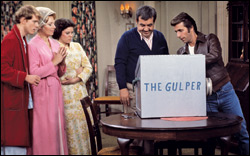
The "Happy Days" lawsuit, one of the most
publicized of the TV cases, may very well be settled before a scheduled
July 17 trial. Henry Winkler and Ron Howard are not part of the suit,
which Williams, Most, Moran, Ross and Patricia Bosley (widow of Tom
Bosley) filed last year seeking at least $10 million, noting their
likenesses used for homevideo sales and on T-shirts, board games,
greeting cards and slot machines. They claim that CBS and Paramount kept
them in the dark by failing to provide revenue statements.
CBS
and Paramount denied the claims but acknowledge that they
"misidentified" the Fonz wallet as containing only the image of Winkler
and therefore was issuing checks for the grand total of $25.75 each.
They also claimed in court documents that other merchandising revenue
from a series of action figures was excluded by the statute of
limitations. Last year, a judge threw out the punitive damages portion
of the case.
Nevertheless, a Los Angeles judge ruled in June that
the case could go forward. One of the central questions is whether the
actors were entitled to potentially lucrative merchandising revenue. The
cast members say the DVDs count as merchandising and were therefore
covered by their contracts; CBS contends the DVDs were not merchandising
but homevideo, covered by royalty payments in guild basic agreements.
Judge Elizabeth Allen White said the latter argument was "convoluted."
 Jonathan
Faber
Jonathan
Faber, head of the Luminary Group, which specializes in licensing the
likenesses of celebrities past and present, said there's good reason for
claims being brought many years after the fact. "I don't think it is a
change in the law; I think it is a rising level of awareness," he said.
"One actor brings a claim and another says, 'I may be similarly
situated. I may have an issue.'?"
There's also another obvious attraction for a performer bringing a case rooted in his right of publicity: the publicity.
Jon
Pfeiffer, the attorney who brought the "Happy Days" suit, said he was
surprised by the level of coverage, on CNN and elsewhere, after the suit
was filed last year. And he said that after the filing, CBS and
Paramount made other payments to the actors for other merchandise, not
just the Fonz wallet.
Pfeiffer read the comments that people have
left on Web stories about the case and says they "give a pretty good
temperature reading for the public's feeling about the suit."
Consultants
have long talked of the advantage a celebrity has before a sympathetic
jury going up against a faceless studio -- and the advantage may be
especially keen when the famous figure is someone who evokes warm and
fuzzy feelings of nostalgia.
Sony, for instance, is seeking to
compel arbitration in Cassidy's case, while his legal team, seeking a
jury trial, has not been shy about characterizing it as a "swindle"
hatched by the studio to get the teen idol to sign the contract in 1971.
Cassidy's
suit claims the contract gave him not only a stake in merchandising
bearing his likeness, but 7.5% of the net proceeds from the exhibition
of the show and exploitation of underlying property rights, including
all other merchandise. Sony claims that all of the merchandising revenue
owed Cassidy was accounted for back in the '70s, while he points to
more recent DVDs bearing his image.
Clearly, the show and its
merchandising are culturally important more than four decades later.
Cassidy's suit notes that the lunchbox, featuring a Thermos bearing the
image of Keith Partridge, "now has its rightful place in our country's
Smithsonian Institution."






 Post
Post


.JPG)
.jpg)
.JPG)
.JPG)


.JPG)
.JPG)


.jpg)